Inside
Traditional Korean Paper and Its Distinctive Attributes
Hanji falls within the wider paper-making tradition of East Asia, but it also exhibits unique qualities when compared to ..
By Text by Choi Tae-ho, Professor, Department of Wood and Paper Science at Chungbuk National University Photos by Choi Tae-ho
Korea, China, and Japan all maintain a traditional papermaking characterized by the “dipping method,” in which a papermaking mold (a wooden frame with a fine bamboo screen) is dipped into a mixture of pulp fibers and to scoop up a thin layer. Despite this shared method, there are differences between the three countries’ traditions in terms of materials and techniques and ultimately in the end product. However, the traditional handmade paper manufacturing methods of these three countries have been developed to suit the raw materials used, and currently use quite different types of paper making methods. In Korea, the bark of the paper mulberry, known for its long fibers, is the preferred source of fiber for crafting paper. Lye made from buckwheat straw or bean stalks is added when pulping it. What most clearly distinguishes the Korean traditional papermaking is the way in which the pulp slurry is immediately drained from the deckle frame rather than remaining within it, as is done in Japan and China. The traditional deckle frame used in Korea is flat, allowing the pulp mixture to drain immediately through the bamboo screen. Holding this flat wooden frame, a papermaker scoops up the slurry and pours it from the front to the back of the frame, which is called the Apmuljil. The slurry is then scooped up again and poured laterally
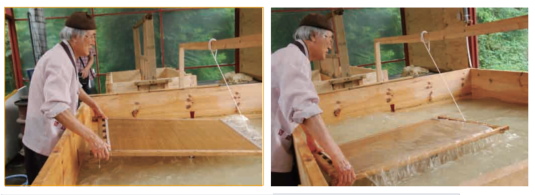
Left A hanji maker scoops up pulp slurry and pours it from the front to the back of the deckle frame.
Right The slurry is scooped up again and poured laterally from side to side.
from one side to the other, which is called the Yeopmuljil. Muljil means sheet forming stroke. These movements are repeated to allow the fibers to accumulate on the surface of the bamboo mesh. This technique is known as Oebal- tteugi. It enables the papermaker to control the fiber orientation and leaves a texture based on intersecting fibers. Traditional Korean paper is called Hanji. It is known for its superb strength and dimensional stability. Another technique worth noting in Hanji-making is the method of layering two sheets of paper in reversed directions and joining them together. This minimizes any difference in the thickness of the paper between the lower and upper ends. Through this layering method, known in Korea as “Eumyangji (yin and yang paper),” an even thickness is achieved across the entire surface and the paper remains relatively proof against curling. Chinese paper, known as Zhuzhi and Xuan paper, is produced using bamboo, rice straw, and the Wingceltis bark. Limestone is added when separating the cellulose fibers from these plants. The resulting fibers are relatively short, but Chinese papermakers take
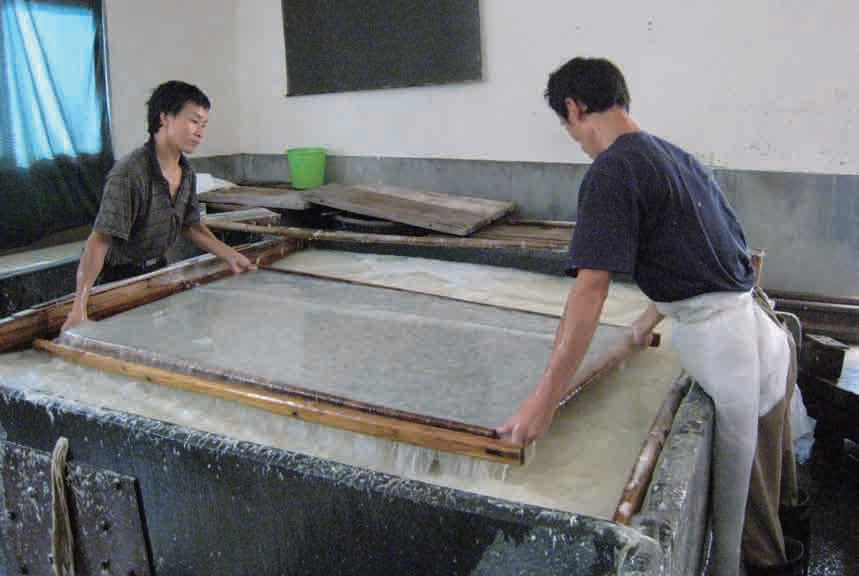
Production of Chinese paper, known as xuan paper
this into account in their production methods. They produce paper sheets by leaving the pulp mixture within the deckle frame until a thin layer of paper web forms on the bamboo screen. Chinese paper is relatively weak in fiber orientation, but the limestone added during pulping results in high mineral content. The preferred plants for making Japanese paper are Kozo(paper mulberry), Mitsumata, and Gampi. The pulping process is aided by the addition of sodium carbonate. Nagashizuki (similar to ‘Ssangbal-tteugi’ in Korea) for making Japanese paper or Washi makes paper by shaking the pulp stock back and forth (not side to side) in a papermaking mold. This allows the productivity and formation are good, but paper with high orientation of fibers according to the direction of shaking is produced. The use of sodium carbonate in the pulping process results in the fibers of Japanese paper clean and uniform compared to Korean and Chinese papers.
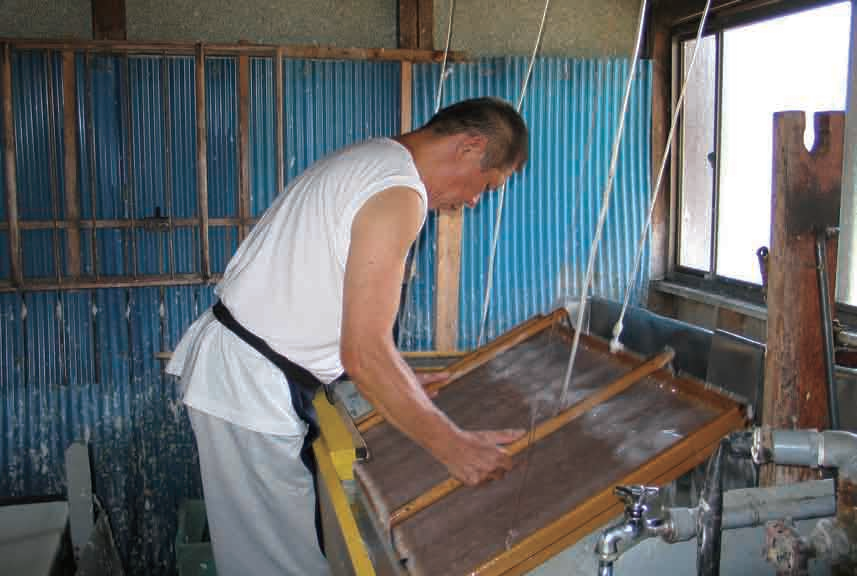
The making of Japanese paper, or washi