Feature
A Century of Evolution of Korean Food
From Korean-style Feasts of the Joseon royal court to Today’s Global K-Food
By Text by Joo Young-ha, Professor in Folklife Studies at the Graduate School of Korean Studies of the Academy of Korean Studies Ph
A Century of Evolution of Korean Food
From Korean-style Feasts of the Joseon royal court to Today’s Global K-Food
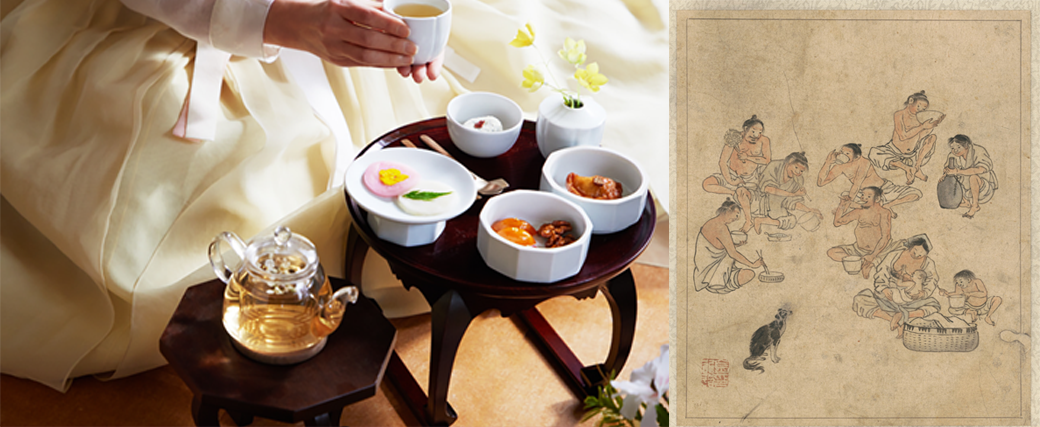
Left
A table with
traditional Korean
snacks (photo
credit: Korea
House)
Right
Jeomsim (“lunch”)
by the 18th-century
genre painter Kim
Hong-do (photo
credit: National
Museum of Korea)
If we could go back in time 100 years to the early decades of the 20th century, we would see a Korea that lagged far behind the West in terms of industrialization and modernization. Korean food, however, could not be considered backward in the least. Through the five centuries of the Joseon Dynasty (1392–1910), Koreans had made the most of the seasonal ingredients they could harvest from their local environment and used them to develop a rich and diverse culinary culture. The Joseon royal court was treating its party guests to a selected sequence of foods and drinks similar to a Western full-course banquet-centuries before such traditions emerged in Europe in the 19th century. Dishes served at royal feasts featured sophisticated cooking techniques and delicate flavors, and the events overflowed with stately formality and dignity. Everyday meals for the Joseon royal family were structured around traditional medical practices for preventing disease. Starting in the 17th century, many royal culinary traditions spread to the aristocracy and commoners as well.
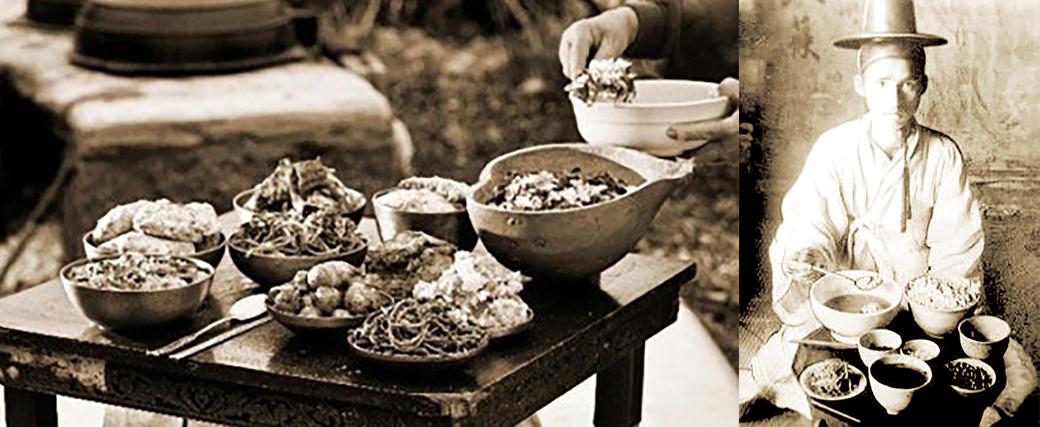
A traditional Korean meal composed of rice, soup, and side dishes
Emergence o of Commercial Restaurants
The culinary traditions of the Joseon era underwent a transformation with the annexation
of Korea by Imperial Japan in 1910. In the early 20th century, many city dwellers in Western
Europe, North America, and Japan were enjoying the fruits of industrialization in their diets,
with an abundance of mass-produced foods available for the table. In contrast, their Korean
counterparts were sticking with traditional home-made meals of rice, soup, and banchan
(side dishes). Unlike their ancestors, however, they had the option to eat out at commercial
restaurants as well. Koreans in such cities as Seoul, Busan, Pyeongyang, Incheon, and Daegu
were able to go out to the Korean, Chinese, and Japanese restaurants that began springing
up in big cities in the early 20th century. Koreans enjoyed a variety of traditional dishes at
restaurants, including seolleongtang (ox bone soup), bibimbap (rice mixed with vegetables
and beef), bulgogi (grilled marinated beef), pyeonsu (rectangle-shaped dumplings), and
naengmyeon (chilled buckwheat noodles). Chinese-run restaurants in Korea also gained great
popularity. In the 1920s, urban families in Korea picked up the practice of making japchae for
festive occasions by mixing glass noodles with stir-fried julienned vegetables and meat and
then seasoning it with traditional soy sauce.
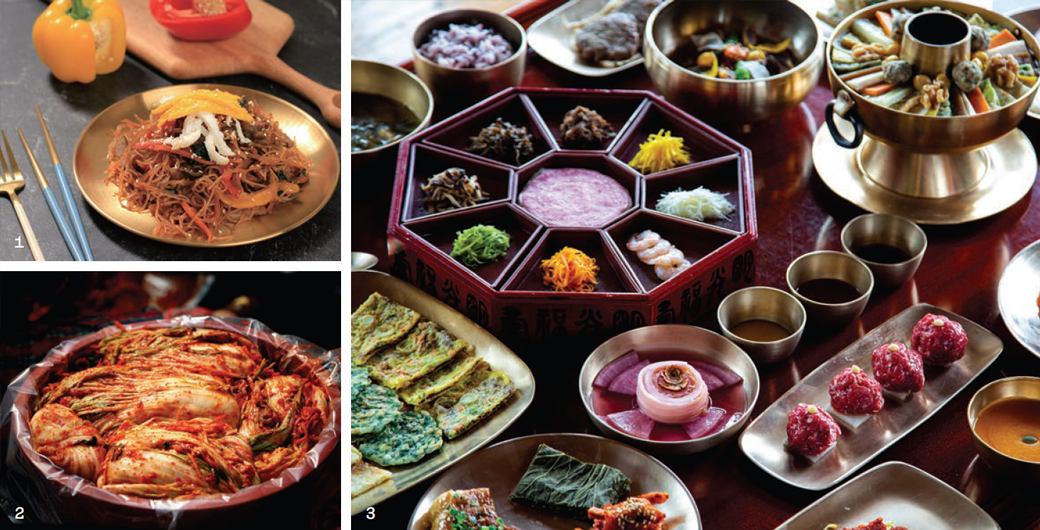
1.Japchae is made
by stir-frying
glass noodles and
vegetables and
seasoning it with
soy sauce
2.Koreans make
large quantities
of kimchi in early
winter to last until
spring
3.Korean food
offering a finedining
experience
(photo credit:
Korea House)
Korea was liberated with the surrender of Imperial Japan to the Allied Forces on August 15, 1945. However, the southern half of the Korean Peninsula was subjected to a temporary U.S. military occupation. Facing severe rice shortages, the United States Army Military Government in Korea banned the use of rice for anything other than consumption as a staple food. The main culprits perceived by the U.S. occupation government as responsible for the shortages were tteok (rice cakes) and the traditional rice brew known as makgeolli. The regulations banning the production of these culturally important foods were met with understandably vehement opposition from the public and ultimately failed to come into force.
The establishment of an independent government in South Korea on August 15, 1948 was followed quickly by the outbreak of the Korean War in 1950. This three-year conflict spanning the peninsula had a devastating impact on the Korean diet. Even during the war, however, Koreans maintained the annual kimchi-making practice of kimjang wherever they could. Families who were able to remain in their homes carried on the tradition of making large quantities of kimchi in November or December, at the start of winter. They kept this kimchi in earthen jars buried underground and sustained themselves for the next four or five months. It is reported that some of the U.N. soldiers dispatched to Korea were taken by surprise seeing Koreans taking food from out of the ground. This practice of burying kimchi jars to regulate temperature continued until the early 2000s when refrigerators specifically designed to store kimchi became widespread. In spring, Korean households with an excess of kimchi from the last year’s kimjang would commonly share it with their neighbors.
Stacks of Tteok as a Festive Food
Korean society was rapidly changing under a governmental development policy that was introduced in the mid-1960s. Farmers moved to cities where they found work as paid laborers. With people concentrating in the cities, a new form of urban dwelling emerged where three generations of a family shared a small home. These urban migrants brought with them the culinary practices they learned in the countryside. For one, they held feasts at home to celebrate such important life events as one-year birthdays, wedding parties, and sixtieth birthdays. When a celebratory meal was being planned, relatives and neighbors chipped in by bringing over dishes or lending a helping hand in the kitchen. Arguably the most important ingredient for these celebratory feasts was tteok. Rice was brought to a neighborhood mill and ground into powder. Male members of the family would pound rice dough with a wood mallet in the small courtyard of the house to make injeolmi (a form of chewy rice cake), while women would prepare baekseolgi by steaming rice powder. These rice cakes were stacked as high as 30 to 50 centimeters on a platter as a reflection of the jubilant spirit of the event.
Birth of New Dishes
As a way to navigate the issue of rice shortages, the South Korean government introduced a
regulation in 1966 requiring breweries to make makgeolli not from rice, but from wheat flour,
large quantities of which were being provided by the United States in aid. The only available
makgeolli soon became wheat flour-based types, which fueled the gradual decline in the
popularity of this traditional beverage. With subsequent improvements in rice production, this
regulation was lifted in 1977 and rice was again allowed in the making of makgeolli. However,
most working-class people had already developed a strong taste for a diluted form of soju, a cheap
alcoholic beverage with a higher alcohol content than makgeolli. However, makgeolli maintained
its relevance within the traditional Korean diet, and experienced a resurgence in recent decades.
From the start of the 2010s, experiments across the country sought to revive and reinterpret the
rice-based makgeolli from before the 1960s. Now, the many types of this traditional milky rice
brew are being made that appeal to different demographics within Korean society.
The mid-1980s saw a mushrooming of restaurants specializing in new forms of Korean food.
They began serving what are now well-known Korean dishes such as bossam (boiled pork
accompanied by kimchi), samgyeopsal (grilled pork belly), chimaek (a pairing of fried chicken
and beer), gimbap (seaweed rice rolls), and tteokbokki (rice cakes simmered in red chili paste sauce), garnering great popularity. These newly invented dishes represented a dietary trend
that began around the democratic transition of Korean society in 1987 toward rediscovering,
reinterpreting, and reinventing traditional Korean cuisine.
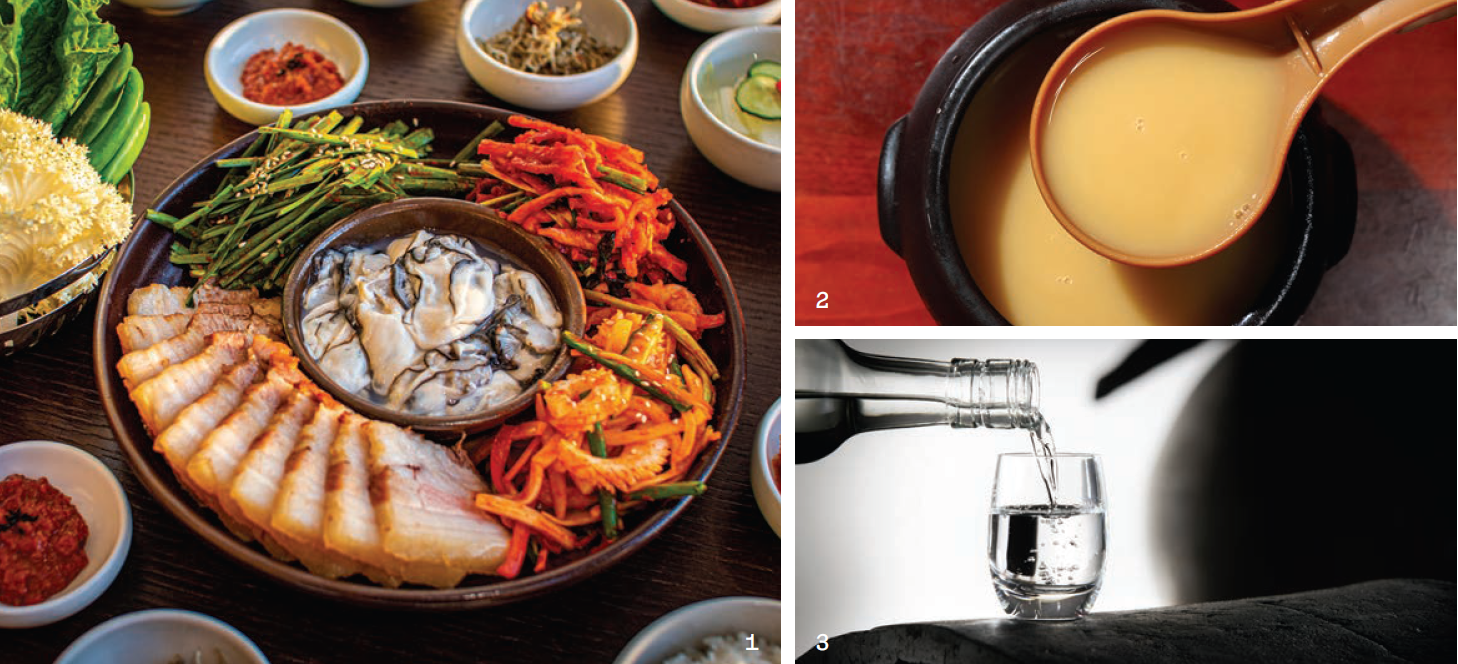
1.Gul bossam,
a pork dish served
with kimchi and
sometimes fresh
oysters
2.Newly developed
variants of the
traditional
Korean beverage
makgeolli are
drawing attention
in today’s South
Korea
3.Soju, along with
the milky rice beer
makgeolli, is a
beloved traditional
alcoholic drink in
South Korea
Korean Food for the World
In a travel diary published after an 1884 journey through the southern portions of Korea, the U.S.
navy officer George Clayton Foulk shared his experience of eating goldongmyeon (buckwheat
noodles mixed with vegetables and seasoned with traditional soy sauce) during a visit to Jeonju.
He considered the dish to be delicious, comparing it to Italian vermicelli. This 19th-century
anecdote was an early hint at the international appeal of traditional Korean food.
The evolution of Korean food over the past 100 years mirrors the tumultuous modern history
of South Korea, which is filled with stories of colonial rule, civil war, breakneck economic
development, democratization, and globalization. Classic Korean dishes narrowly averted
extinction, underwent a variety of adaptations, and embraced new interpretations across the
ups and downs of modern history to eventually become established as a distinctive culinary
tradition with a strong global appeal. It seems a certainty that Korean food will sustain this
process of evolution well into the future.

Korean food is evolving as it absorbs influences from other culinary traditions