Feature
King Yeongjo, a Monarch who Resolved National Crises
By Kim Paek-chol
History portrays heads of state according to how they stood up to national crises and found solutions. The 21st monarch of the Joseon Dynasty, King Yeongjo (r. 1724–1776), is clearly remembered as a compassionate sovereign who introduced a series of innovative policies to address various social ills and improve conditions for his people. One of his most prominent accomplishments is the implementation of a new tax law designed to alleviate the onerous tax burden shouldered by commoners and distribute it more fairly across all groups in the nation. For this reason, it was called the Equalized Tax Law, or Gyunyeokbeop. (Note by the Editor)

Portrait of King Yeongjo
King Yeongjo was the 21st monarch of Joseon. Spanning a remarkable 52 years,
he maintained the dynasty’s longest reign. He is considered a compassionate
sovereign who introduced a series of innovative policies on behalf of his people.
(Photo courtesy of the National Palace Museum of Korea)
Military Service Reform
The Joseon Dynasty designed its fiscal system mainly around three forms of tax—the land tax, tribute tax, and obligation to perform military service and corvee labor. In exchange for the plots of land they worked, people were obligated to pay a portion of their harvest as a land tax. The tribute tax called on every household to provide the central government with a range of products found in the area. In addition, able-bodied men could be called up for service in the army or for labor at construction sites. This system of duties continued through the 15th century, but over the course of the 16th century people came to primarily deliver all their tax obligations in the form of rice or cloth, items which served as a form of currency in Joseon society. This shift in people’s tax-paying practices indicates that the Joseon economy was undergoing a structural transformation toward a more monetary economy.
From the early 17th century, a minimum rate was applied to the tax imposed on land; and by the early 18th century the tribute tax, which imposed a considerable burden on people’s lives, was completely replaced by a less troublesome land tax paid in rice under the Uniform Land Tax Law (Daedongbeop). The sole remaining heavy tax was the requirement for military service and corvee labor, an obligation which people mostly avoided by offering bolts of cotton cloth as a form of exemption. With the military requirement being fulfilled with cloth, its payment could be directly translated into state income. The problems of this period were exacerbated by a combination of a declining population with growing military expenses. The foreign invasions were accompanied by a severe famine that reduced the number of eligible taxpayers. Meanwhile, however, the external attacks pointed out the need to shore up defenses, which resulted in the establishment of five new military garrisons. Furthermore, a growing number of registered taxpayers—not only members of the yangban aristocracy, but also affluent commoners—were able to evade their military service duties and transfer a disproportionate burden onto ordinary commoners. Faced with the heavy military service obligation, some commoners would even abandon their land and flee.
Around 17th century, commoners were becoming the sole source of revenue for the government. Their number and their capacity to pay taxes were considered a determining factor for the future of the state. With the decline in the population and the expansion of tax evasion, however, the government had to come up with a response to the depletion of government funds. This was the background of the debate over tax reform.
Along with the nationwide application of the Uniform Land Tax Law, a first round of reforms was implemented in the later years of the reign of King Sukjong (r. 1674–1720) that standardized the military service exemption tax at two bolts of cotton cloth. Discussions on tax reform continued into the reign of King Yeongjo. A series of ideas was aired over the span of about 100 years. There was a proposal to search out and include in the pool of taxpayers those who had illegally avoided their military service obligation. This was followed up by another suggestion to impose the military service exemption cloth tax on every household across all social classes. A rather radical idea was also put forward arguing for the imposition of this cloth tax on every able-bodied man regardless of his social status. There was another idea—similar to the Uniform Tax Land Law—to correlate the levying of the cloth tax with the amount of land possessed. Despite the extended discussion over tax reform and the diverse proposals offered, a final decision was hard to reach. Meanwhile, there was a growing concern that the current taxation system placing a disproportionate burden on commoners was delivering a severe blow to the future of the state. The need to subject the yangban aristocracy to a tax-paying obligation gradually became clear.
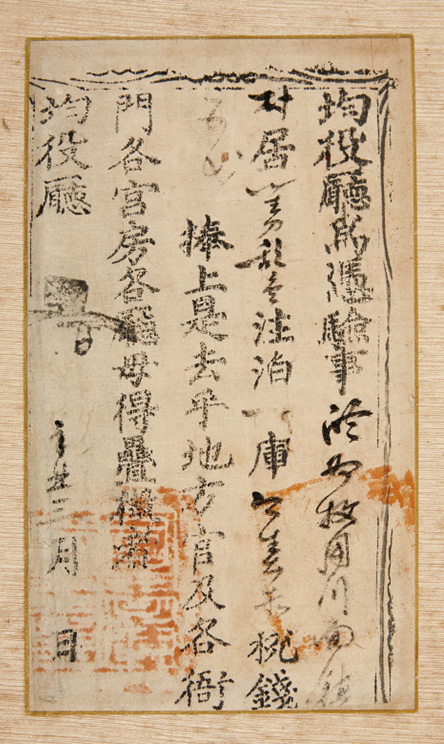
Tax Receipt
This is a tax receipt issued by the Equalized Tax Service.
These receipts, called mulgeumcheop
(“orders not to violate the rights of the holder”),
were used as evidence to prevent double taxation.
(Photo courtesy of the Suwon Hwaseong Museum)
Listening to the People
King Yeongjo wanted to abolish the existing military service tax system altogether and introduce a new policy, as discussed above. However, a new policy alone could not solve the entire problem. At the time, social stratification had been taking place across the social classes—not only were commoners splitting into rich and poor groups, but also the aristocracy was becoming divided between successful families and declining ones maintaining their yangban status in name only. Without the adoption of a new classification standard based on economic capacity, no new policy could deliver its intended effect. During the decision-making process, King Yeongjo held three sessions of “inquiring into his subjects” (sunmun) where he listened to opinions from ordinary people. In the end, King Yeongjo decided to revise the existing system and completed the tax reform process. From this was born the Equalized Tax Law, the main ideas of which are as follows.
First, the tax paid in cloth in exchange for an exemption from military service was cut from two bolts of cotton cloth to one. The expected loss in revenue was to be made up for through other measures. This reduction in the cloth tax helped restore a measure of stability to the lives of commoners.
Second, taxes on fish traps, salt production, and vessels were added to the treasury of the central government. The right to collect these taxes had been held by the royal family, but it was transferred to the government as part of efforts to reduce tax rates. This loss to the income of the royal family was translated into an increase in government revenue.
Third, a cloth tax was imposed on wealthy commoners who had avoided military service by pretending to be of yangban status. To search them out, a new position was created called a seonmu gungwan (“selected military officer”). Wealthy tax evaders were encouraged take the examination to become “selected military officers.” Those who passed the examination were recognized as the new social class of “middle people,” one step up from the commoner class in the social hierarchy of Joseon, and granted immunity from the military service exemption tax. Those who failed remained subject to the ordinary tax rate of one bolt of cloth, but they were still endowed with this new social status.
Fourth, a form of taxation reflecting economic means was introduced. The tax deficit was originally allocated across the local provinces, but the measure soon turned out to be too burdensome for the local governments. Collecting an additional tax based on land, the primary yardstick of economic means, was suggested as a practical alternative. Hence a grain surtax was imposed on land. Those who were subject to this grain surtax were members of the yangban class, wealthy commoners, and local civil servants who owned plots of land. Ordinary commoners did not need to pay this new tax.
Profound Effects Across Society
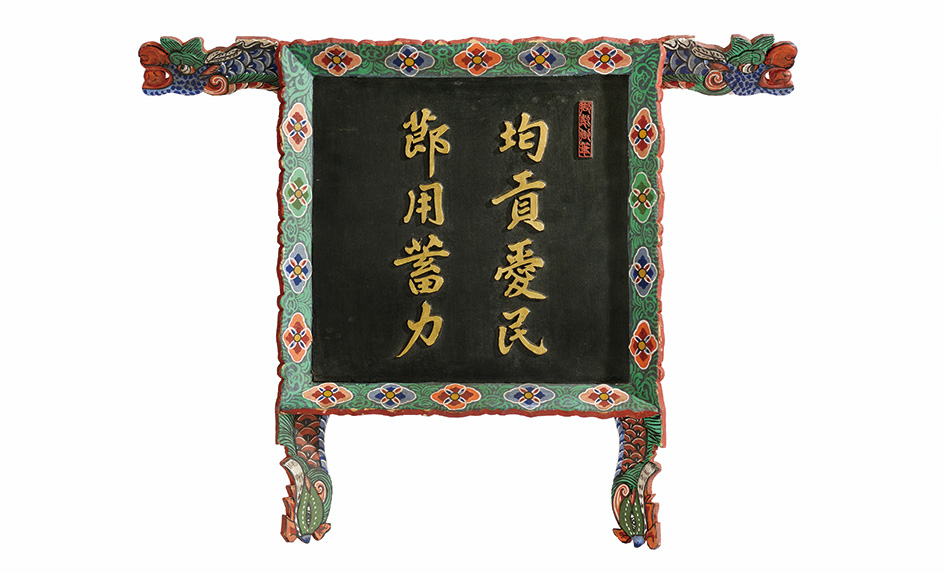
Plaque Bearing Yeongjo’s Calligraphy
This plaque was created in 1744. The phrase written on it was composed and executed by King Yeongjo. It reads, “Care for people through equalized taxes, and accumulate power through savings.” (Photo courtesy of the National Palace Museum of Korea)
The tax reform executed through the implementation of the Equalized Tax Law had far-reaching effects across Joseon society. First, the management of government revenue became more integrated. A central financial office called the Seonhyecheong (Uniform Land Tax Service) was established as part of the Uniform Land Tax Law. The funds accumulated at the Uniform Land Tax Service were utilized to make up for losses in revenue generated over the course of shifting from the existing military service tax system to the Equalized Tax Law. The Gyunyeokcheong (Equalized Tax Service), an office installed for the operation of the Equalized Tax Law, was later merged with the Seonhyecheong to create a more powerful agency for central government finances.
Secondly, the focus of the state’s economic policy was shifted from agriculture to commerce. King Yeongjo held regular sessions for listening to the opinions of government purchasing agents (gongin) and government-licensed merchants (siin). He also designated a special economic official with the task of managing merchants and addressing their issues. This testifies to the priority the merchant group was given in Joseon’s economic policy at the time.
Third, the social class system of Joseon was reorganized with “middle people,” commoners, and nobi (“serfs”) all receiving better treatment than before. After the tax burden on commoners was reduced by the Equalized Tax Law, a tax reduction was also granted to the state-owned serfs (gongnobi) who formed independent households like commoners. This tax benefit can be thought of as an extension of the Equalized Tax Law. The revenue loss resulting from this measure was actually made up for by the Equalized Tax Service.
Fourth, the Equalized Tax Law engendered a change in political philosophy that can be confirmed by accounts in the Journal of the Royal Secretariat (Seungjeongwon ilgi). When the Uniform Land Tax Law was enforced nationwide during the reign of King Sukjong, its meaning was considered “stabilizing the people and enriching the state.” After the enactment of the Equalized Tax Law, King Yeongjo took it a step further and commented, “The monarch exists for his people, not the other way around. ... If the monarch is incapable of protecting his people, his throne is nothing but a subject for revolution.” The 18th century saw the emergence of a more people-centered concept of state, or minguk (“people and state”), in Korea. It is considered that the tax reforms implemented during this period served as a driving force for the birth of this new political concept in Korea.
Text by Kim Paek-chol, Professor in History, Keimyung University
Photos by the National Palace Museum of Korea and the Suwon Hwaseong Museum

국가의 위기를 돌파한 군주
국가가 전염병, 천재지변, 전쟁, 재정난 등 각종 위기 상황에 빠졌을 때 군주가 그 난국을 어떻게 해결하고 돌파했는지에 따라 역사의 평가가 달라진다. 조선 21대 임금인 영조(1694~1776)는 18세기의 조선을 중흥기로 이끈 군주로, 민생을 위한 정치를 펼치고, 여러 정책을 통해 국가의 위기를 극복해낸 성군으로 꼽힌다. 특히 세금 제도의 변질과 폐단으로 백성들이 고통 받고 사회의 질서가 흐트러지자 세금 개혁인 ‘균역법’을 단행하여 국가의 안정을 도모했다. (편집자 주)
공역의 개편을 논의하다
조선은 15세기 전세(田稅)-군역(軍役)·요역(徭役)-공납(貢納)을 백성들에게 직접 수취하는 체제를 토대로 국가 전반을 운영하였다. 토지에 대해 쌀로 부가하는 현물화폐 성격의 ‘세금’과 양정(良丁)이 몸으로 부담하는 ‘군역’ 및 ‘요역’, 그리고 다양한 진상품을 납부하는 ‘공납’ 등으로 구성되었다. 그러나 16세기를 거치면서 전세-군역·요역-공납 등이 모두 쌀이나 포(布) 등의 현물화폐로 납부하는 형태로 점차 금납화(金納化)하였다. 기본적인 국가 조세체계의 변화는 이제 현물이나 노동력을 중시하던 사회적 가치가 현격히 화폐를 중심으로 하는 새로운 경제체계로 급속히 변화하고 있음을 보여준다.
17세기 초반부터 전세가 최저 세율이 되었고 18세기 초반에 이르면 공납마저 대동법으로 세금이 경감된 상황에서, 오직 양역만이 경제력을 반영하는 토지에 직접 연동되지 않아서 백성에게 큰 부담으로 남았다. 더욱이 양반뿐 아니라, 부유한 양민 중에도 양반을 모칭하여 피역하는 행태가 늘어나서, 남은 소민(小民, 열악한 백성)만으로 양역을 감당하기에는 무리였다. 당시 양인에 대한 세수(稅收)는 국가의 재정 그 자체로서 인식되었고, 이제 백성의 부담은 국가의 운명을 좌우할 만큼 중요한 요소가 되었다. 금납화로 단일화된 세정(稅政)에서 모든 백성의 부담은 곧 국가 재정의 총액과 동일하게 치부되었다.
17세기의 난점은 전란과 대기근으로 단기간에 인구가 급감하는 경우가 잦은데도, 오히려 불안정한 대외정세로 5군영이 차례로 창설되어 군비가 늘어났다는데 있다. 양역(良役, 군역)은 금납화되었으므로 비단 군비(軍費)일뿐 아니라 중앙재정으로서 막대한 비중을 차지하고 있었다. 대기근으로 인구가 짧은 기간동안 급격히 변화함으로써, 조정은 재정절벽을 우려해야 하는 상황에 직면하였다. 이 문제를 해결하기 위해서 양역변통(군역개혁)논의가 진행되었다.
18세기 숙종후반부터 대동의 확대 실시와 함께, 양역가를 2필로 바로잡는 1차 균역이 이루어졌다. 그 연장선상에서 영조대 균역법이 추진되었다. 약 1세기동안 유포론(游布論), 호포론(戶布論), 구포론(口布論), 결포론(結布論) 등이 거론되었으나 공법을 안정시키기 위한 대동법을 정착시키기에 급급한 상황에서, 양역을 위한 균역까지 실시할 여력은 없었다. 유포론은 세금을 내지 않고 있는 양정을 찾아내서 세금징수를 늘리자는 논의이다. 유포론 논의가 확대되자 호포론이 등장하였다. 이것은 신분에 관계없이 가호(家戶)마다 포(布)를 내도록 하자는 주장이다. 또한 급진적인 구포론까지 등장하였다. 구포론은 신분에 관계없이 인정(人丁)마다 면포를 내는 방안이다. 결포론은 대동법과 같이 토지의 다과에 따라 세금을 부과하자는 주장이다. 조야(朝野)에서는 계속 소민에게 과중한 부담을 지속시킬 경우 나라의 존망이 위태롭다는 위기의식이 팽배하였다. 세금을 부담하는 대상에 양반을 포함시키자는 목소리가 점차 커졌다.
백성에게 의견을 묻다
국왕은 양역을 전부 폐지하고 새로운 세제로 바꿀 것을 기대하였다. 하지만 당시 양인은 부유한 백성과 궁핍한 소민으로 계층분화가 이루어졌으며, 양반조차 출사해서 가문을 보존하거나 지역에서 경영에 성공하여 경제력이 있는 계층과 몰락한 잔반(殘班)이 병존하였다. 양인과 양반 모두 경제력에 따른 재분류를 선행하지 않는다면 국가에서 수세재원을 안정적으로 확보할 수 없었다. 이에 영조는 3차례나 궁궐에서 순문(詢問)을 열어 백성에게 세제개혁안에 대한 의견을 물어보고 균역법을 최종 타결하였다. 그 주요 골자는 다음과 같다.
첫째, 감필(減疋)이다. 새로운 대체세원을 충분히 마련하기 어려웠으나 절반은 가능하다는 판단하에 선제적으로 양인의 역가를 2필에서 1필로 낮추었다. 이로써 소민의 가계는 안정을 되찾았다.
둘째, 어염선세(魚鹽船稅, 어장세·염세·선세)이다. 영조 초반 진휼재원 마련을 위해서 개발된 염분(鹽盆, 소금공장)을 중심으로 바다에서 나는 모든 이익을 중앙재정으로 귀속시켰다. 어염세는 그동안 왕실과 궁방(宮房) 등이 폭리를 취해온 과중한 세금으로, 저율과세로 바꾼다는 명분하에 수세권을 조정에 귀속시켰다. 곧 왕실의 희생으로 국가재정이 확보된 것이다.
셋째, 선무군관포(選武軍官布)이다. 부유한 양인 중 양반을 모칭하여 피역하고 있던 이들을 찾아내서, 선무군관 선발절차를 거치게 함으로써 수세대상에 편입시키는 정책이다. 취재(取才)를 통해서 군관이 되면 자연히 중서층(中庶層)으로 인정하고 면세혜택도 받았다. 다만 통과하지 못하면 본래의 세금이 부여되지만 새로운 사회신분은 인정해주었다.
넷째, 지방의 재원을 활용하고 경제력에 기초한 과세가 이루어졌다. 처음에는 부족한 재원을 외방에 부담시키는 분정(分定)이 이루어졌으나 각 고을의 경상비 지출조차 어렵게 만들었으므로 지속되기 어려웠다. 이 때문에 경제력의 척도인 토지에 과세하는 방안이 현실적 대안으로 떠올라서 결전(結錢, 토지에 부과하는 세금)가 시행되었다. 양자는 모두 지방세를 중앙세로 편입시킴으로써 백성은 새로운 세금을 부담하지 않아도 되었고, 중앙도 급대재원을 마련할 수 있었다. 특히 토지를 소유한 양반이나 부유한 양인, 지방아문까지 수세대상에 편입되었다.
세제개혁, 사회를 움직이다
세제개혁은 비단 세금부담의 형평성만 제고시킨 것이 아니었다. 부수적 효과가 수반되었다. 첫째, 국가재정의 일원적인 통합운영이 강화되었다. 이미 숙종대 대동법의 실시로 중앙재원이 확보되면서 선혜청이라는 새로운 중앙재정 기구가 만들어졌는데, 여기서 비축된 재원은 균역법 시행과정에서 감면된 세수를 대신하는데 활용되었다. 균역청이 선혜청과 통폐합되자 거대 재정기구로 탈바꿈하여 세금체계의 통합성은 현저히 높아졌다.
둘째, 조정의 경제정책 기조가 바뀌었다. 균역법 완성후 영조는 순문의 주요 주제를 농형(農形, 농촌 문제)에서 공시(貢市, 상업 문제)로 바꾸었다. 공인(貢人)과 시인(市人, 시전상인)을 불러 폐막을 묻고 이를 전담하는 공시당상(貢市堂上, 특별 경제장관)을 설치하였다. 국왕은 공시순문(貢市詢問)을 정기적으로 열었다. 정책대상이 공인과 시인에게까지 확대된 것이다. 이미 서울은 상업도시가 되어 공인과 시인의 역할이 큰 비중을 차지했다.
셋째, 사회신분의 범주가 재편되었다. 서얼, 선무군관, 공시인에 이어서 공노비까지 신분이 변화하였다. 대동과 균역으로 양인의 문제가 해결되자, 외방에 거주하면서 농민처럼 농사를 짓는 공노비도 신공(身貢)이 감면되었다. 이념적으로 균역법에서 양역감면 정책의 연장선상에서 공노비의 신공감면이 이루어졌을 뿐만 아니라, 실제로도 급대비용도 균역청 재원으로 이루어졌다.
넷째, 세제개혁은 정치사상의 변화까지 이끌었다. 대동의 효용은 숙종대 “백성을 편하게 하고 나라를 넉넉하게 한다”고 평가되었다. 균역이 타결되자 영조는 한걸음 더 나아가, “백성을 위해서 군주가 있는 것이지, 군주를 위해 백성이 있는 것이 아니며”, “백성을 구제하지 못한다면 임금의 자리에 있어도 독부(獨夫)에 지나지 않는다”는 과격한 발언을 주저하지 않았다. 이른바 18세기 탕평정치기 ‘민국(民國)’ 이념은 대경장(대대적인 개혁)의 여파로 탄생한 것이다.
Text by 김백철 | 계명대학교 사학과 교수
Photos by 국립고궁박물관, 수원화성박물관