
Feature
Ceremonial Attire and the Frugal Majesty of the Joseon Royal Family
Ceremonial Attire and the Frugal Majesty of the Joseon Royal Family
By Lee Min-joo, The Academy of Korean Studies Photography by National Palace Museum of Korea, National Museum of Korea
Records of Royal Cuisine
The royal cuisine of the Joseon Dynasty (1392–1910) has been designated as a National
Intangible Cultural Heritage for its informative representation of traditional Korean food.
Royal food was prepared with the utmost care for a wide range of ceremonial events for the
king and other members of the Joseon royal household. Information on the dishes served
at birthdays, weddings, and death anniversaries of royal members can be found in various
historical documents, including Joseon wangsil uigwe (Royal Protocols of the Joseon Dynasty),
Eumsik balgi (Record of Food Offerings), Joseon wangjo sillok (Annals of the Joseon Dynasty),
Seungjeongwon illgi (Diaries of the Royal Secretariat).
These historical records offer details on the procedures of royal ceremonies, including how
ceremonial foods were set on the table, what types of cooking utensils were used, what kinds
of ingredients were applied, and the names of the various royal dishes. However, the surviving
recipes for Joseon royal cuisine are not derived from these documents. Instead, they have
been transmitted through a lineage of practitioners who learned them from Han Hui-sun
(1889–1972), a court lady who served the final members of the Joseon royal household.
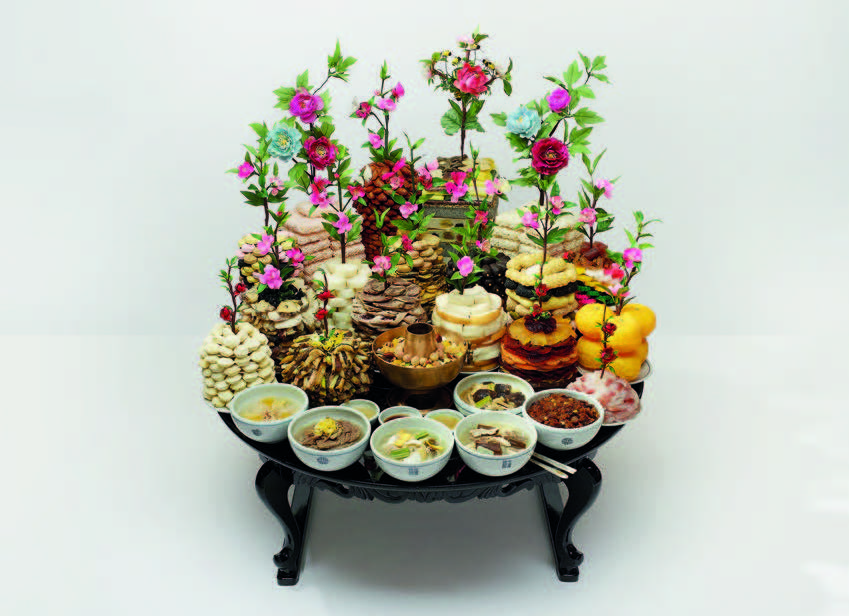
This image shows the appearance of a special afternoon confection set known as juda byeolbangwa. The king of Korea would receive a juda byeolbangwa instead of a normal confection table when greeting honored guests or on other special occasions.
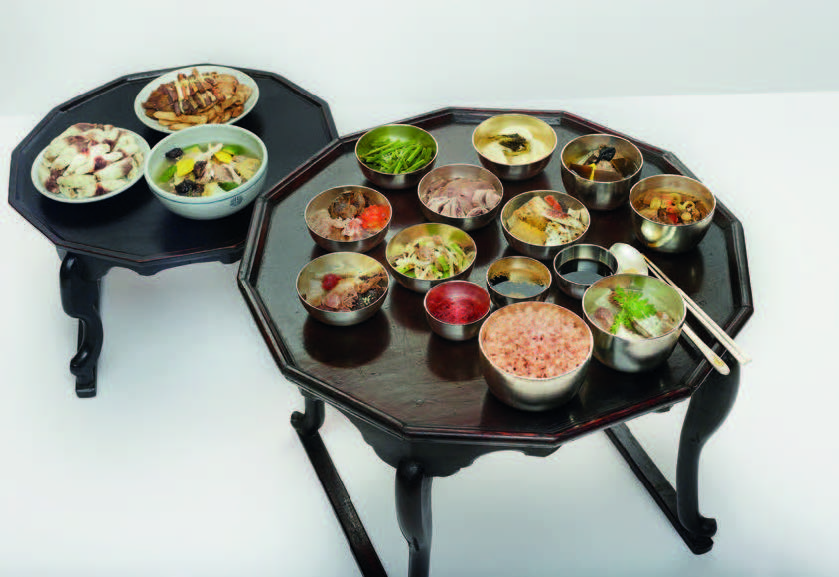
Meals for the king of Korea consisted of 12 side dishes in addition to a bowl of rice and some other fundamental side dishes. He would only start eating after a eunuch or court lady had sampled the dishes and ensured there was no poison.
Royal Chefs
During the Joseon Dynasty, the food for the royal household was systematically prepared by trained professionals. The office responsible for the food served to the royal household was known as the Saongwon (the Office of Royal Cuisine). The suksu (skilled male cooks) affiliated with this office played a primary role in preparing royal food. The suksu from the Office of Royal Cuisine divided their labor according to their respective specialties. They were composed of a lead cook (known as the bangam) and rank-and-file saekjang cooks specializing in different areas. Byeolsaong (there were cooks dedicated to cooking meat), Sangbaesaek (table setting), Bangong (steaming rice), Jeoksaek (grilling), Pojang (preparing tofu), Byeonggong (making rice cakes), and Jusaek (producing alcoholic drinks). However large the given task might be, the suksu of the Office of Royal Cuisine were able to function efficiently by focusing on their areas of expertise. Suksu are depicted in Seonmyojo jejae gyeongsuyeondo, a painting produced in 1605 describing a royal banquet held to celebrate the longevity of the mothers of court ministers. In this Joseon-era painting, various suksu are depicted holding a knife, starting a fire, and setting
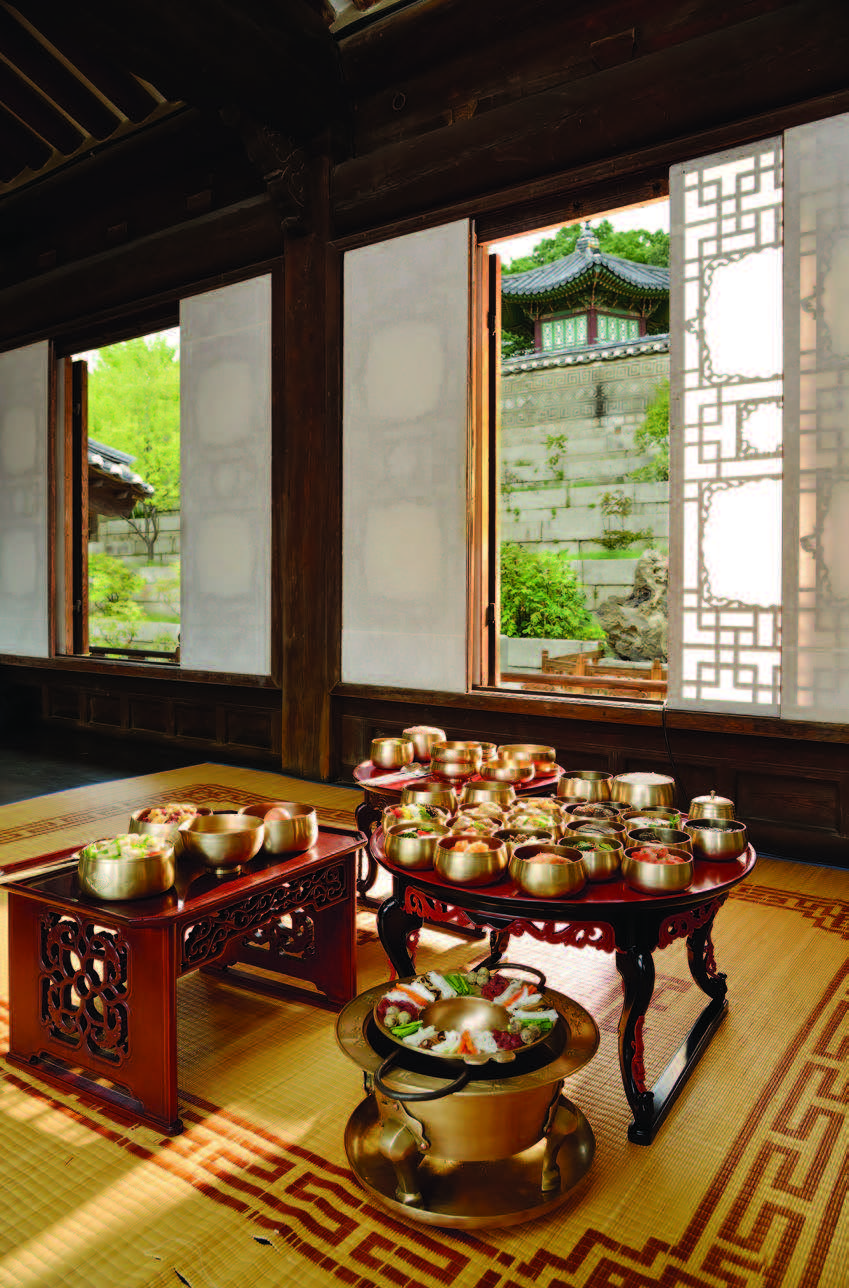
A recreation of royal meals for the king from the late 1800s, prepared according to Han Hui-sun’s instructions
the table. The job of suksu was often passed down within families. When large-scale royal
banquets were planned, the most talented among the group would be called in. Some of these
suksu ended up earning great esteem from the Joseon kings.
Suksu had assistance from eunuchs and court ladies as they prepared meals for the king. The
chief of the eunuchs at the palace, the Sangseon Naegwan, was responsible for the quality and
safety of royal meals. The chief eunuch would inspect the ingredients and taste the dishes
on the royal table to ensure that there was no poison. This safety-management process was
known as gimi. The queen consort or crown prince sometimes participated in this process.
Court ladies would also often take on this role toward the later period of the Joseon Dynasty.
Court ladies, or gungnyeo, held ranks ranging from junior rank 9 to senior rank 5. Court
ladies holding senior rank 5 were known as sanggung and held considerable power. The living
quarters for royal family members at the palace came with auxiliary spaces for preparing
meals (sojubang) and making confectionaries (saenggwabang). The court ladies assigned to
the living quarters worked in these kitchen areas. Sanggung attended to the king while he was
eating by keeping a stew boiling and delivering dishes.
Transmission of the Royal Tradition
The bureaucratic reforms enacted in 1895 during the reign of King Gojong (r. 1863–1907) significantly reduced the size of Korea’s government, and many of the suksu cooks were let go. However, there remained court ladies serving the royal household and carrying on the royal cuisine tradition. One of them was Sanggung Han Hui-sun. After the end of the dynasty, the royal household food customs gradually faded from the consciousness of Korean people. The processes of modernization and the concomitant social and political turbulence brought about further changes in Korean food. Eventually, the royal cuisine of the Joseon Dynasty attained the status of National Intangible Cultural Heritage in 1971. Sanggung Han Hui-sun was recognized as the designated holder of this tradition. Han began her palace life at age 13 as a kitchen trainee at Deoksugung Palace. She spent long years in the royal kitchen serving meals for King Gojong, King Sunjong (r. 1907–1910), and Sunjong’s queen consort as she rose through the hierarchy to become a sanggung. As the authorized heritage holder of Joseon royal cuisine, Sanggung Han Hui-sun transmitted the skill by personally demonstrating how to cook it. Han played a critical role in passing down this royal food tradition to the present.
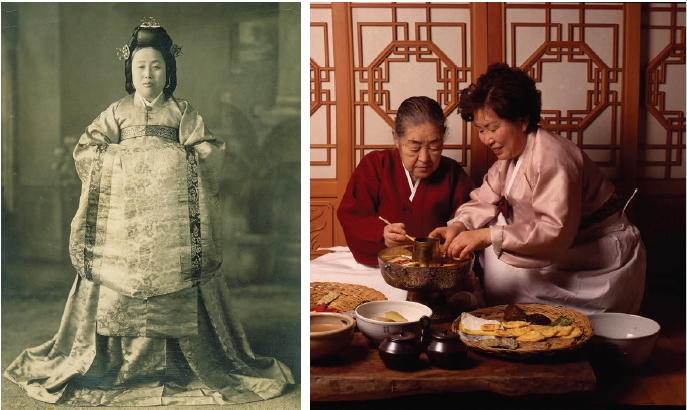
Left
Han Hui-sun
was among the
last generation of
Korean court ladies
serving royal meals.
Designated as the
holder of royal cuisine
preparation in 1971,
she played a critical
role in transmitting
the tradition to the
present.
Right
Hwang Hye-seong,
the second holder,
Han Bok-ryeo, the
third holder, of royal
cuisine making,
contributed to
systematizing the
tradition.
Professor Hwang Hye-seong (1920–2006) was among those taught by Sanggung Han.
Professor Hwang’s apprenticeship with Sanggung Han commenced in 1942, around the time
when Hwang started teaching home economics at Sukmyung Women’s Vocational School.
Hwang learned from Han for the following 30 years until her death in 1972. Afterwards,
Professor Hwang became the second authorized holder of Joseon royal cuisine. Hwang is
considered to have modernized traditional recipes and established the academic awareness
of this Joseon-era tradition. Professor Hwang made significant contributions to repositioning
the royal cuisine of the era not just as a skill, but as a pillar of the nation’s intangible heritage.
Professor Hwang passed the baton to Han Bok-ryeo (1947–present) and Jeong Gil-ja (1948–
present), the current authorized holders of Joseon’s royal cuisine respectively specializing in
royal food and royal confectionaries. Beyond their primary mandate of passing down this
tradition to future generations, these two third-generation holders have dedicated themselves
to disseminating the significance of royal cuisine across contemporary Korean society through
education, research, and awareness-raising efforts. They are sparing no effort at nurturing
new royal cuisine professionals, with roughly 30 such experts having been taught by them
as of 2025. Along with their two teachers, these royal cuisine professionals have dedicated
themselves to giving lectures, publishing books, and holding cultural events with a view to
spreading the royal food tradition further among the public.
The royal cuisine of the Joseon Dynasty represents the dignity and authority of the ruling
household. Every step in the process of making royal food had to be done in accordance
with stringent protocols. Royal food was prepared with a systematic division of labor and an
uncompromising spirit of professionalism.
The royal food of the Joseon era is not just fossilized in history. Today, it comes alive through
diverse research and educational and experience programs, integrating itself into Korea’s wider
food culture. Joseon’s royal food tradition puts the change of the seasons, the rules of nature,
and the hearts of its makers on the table. These virtues strongly appeal to contemporary people
who seek to enjoy the art of food as a full-body sensory experience. The food of the royal
households of the past has made its way into people’s everyday lives as a carrier of traditional
virtues and a new medium to experience in the present.